10.14.2015

POTATO

   Between Jes and I, "potato" is a word. Not a concept, not a title, not even the obvious name for a specific underground vegetable. In the very beginnings of our relationship (some might specify the period as mere friendship), it was a word I said at random, to break the tension of not knowing what else to say. As my social skills are often lacking, silence is usually the response I give in normal contexts, but this was an online chatroom, a whole other ballpark. Silence connotated an air of ignoring someone. If you wanted to show interest, and you weren't a normal conversationalist like everyone else, you had to speak up, even if what you typed made absolutely no sense. At least you were there; at least you were alive. 
   So, I'd type "potato." We used it in Scrabble, we used it as an insult, it was the scapegoat in everyday conversation. Among a slew of other hat-choices, "potato" stuck almost like a cuss word in our vocabulary. Ironically, it became a flavor-enhancer, and only we were in on the joke. We had even considered buying one of every variety and handing them out as Christmas presents to each of my family members. (My dad would get the fingerling.) What had originally started as a reason for Jes to call me weird now brought her under that umbrella: we were "the odd couple." And you could say bananas were equally responsible.
   So there you have it. "Potato" means a lot to us, and we're not really sure why. 

   Potatoes, on the other hand, seem to present themselves as the ultimate kitchen challenge, for myself at least. I mean, if vegetables are supposed to be easy to cook, then potatoes do not deserve to be categorized as such. Indeed, they'd probably be much more comfortable at the bottom of the pyramid.
   I must tell you about my potato stigma. I do not have the patience to cook potatoes. In fact, I very much dislike including them in any meal because of it. And I had long known that they take some extra time to reach the perfect doneness, had even unveiled secrets in my research which called for cutting potatoes in order to speed the cooking process.
   But when I decided to tackle them for the first time, in 2011—two whole months before meeting Jes in person—I had babysat them for what I was certain was borderline too-long, only to find that seasoning and plating them only made them look appetizing. The luster they lacked was obvious upon the first bite: they had simply refused to cook through. I've never resorted to using a microwave oven to actually cook something, but that was probably the closest I'd ever come to doing so. I had given up hope, and would rather stomach their undercooked bodies than heat-treat them once more for an indefinite period of time.

August 11, 2011 - Balsamic Steak

   Ignore the "steak" off to the left that appears to be crying tears of shame. There are plenty of excuses for that to be heard. But also note the date. This was four years ago. My skills, creativity, plating design, and nearly every other aspect of my former self have changed since. Only my hatred for preparing potatoes remains the same.
   OK, that's not entirely true. For one, I'm no guru when it comes to meat; but at least I can judge when it's done without cutting it open. Potatoes, however, must be in my mouth before they can disappoint me. Not a month later, I took the rest of that sack and tried again, as yet another side to a horribly cooked cut of steak. Hey, I've had high hopes for every meal I've ever crafted. It's just the fact that both of them came out unsatisfactory which shows they ended up being paired pretty evenly.

September 30, 2011 - S&P Swiss Steak

   To quote my feelings after this meal, "I do not like cooking them." There are mushrooms in there as well, and a dab of sweet hot sauce I had received as part of an online order. That probably explains the burnt goodness that tried to hide the undercooked starchiness. And I don't know what it is about steak that just begs to be paired with potatoes, but this was, in fact, the last time I put the two together—not that I stopped cooking either of them, but where I got better with beef, the other became the bane of my kitchen experience.
   Fast-forward to life with Jes. She loves mashed potatoes and doesn't mind the instant kind. I'm not a fan of mashed, but I'll eat it; I much prefer baked, and separate entirely from Jes's tastes, I think sweet potatoes are amazing. Yes, I know they're not technically potatoes. No, I don't care. But, both of us thoroughly enjoy roasted potatoes, and I am thankful that Jes has such oven expertise that she can rectify my stovetop failures.

January 10, 2015 - "Aside" Dish

   Remember those high hopes I'd mentioned? These red potatoes were originally sautéed in a pan that I had just finished sizzling shrimp in, for the fabled ramen meal of repurposed legend. I added a splash of white cooking wine and a couple of pieces of butter, then tossed these "cubes" in and did my worst. Finally, when I admitted to Jes that I could not successfully tend to potatoes, I handed over the baton and she roasted them to the perfection seen above.

Deli-cious

   After reading up on those deviled eggs we made, Jes had a sudden hankering for all things hard-boiled. Well, mainly just eggs. She made me buy a dozen in this expensive economy—there's been an egg shortage nationally, or something—on my way home from work. But, apparently, potatoes were also on her mind.
   Visit a deli and it'll be easy to see that potato salads are very popular, so much so that there's usually more than one kind (three-potato and red-skin, to name some). My absolute favorite happens to be an Oktoberfest specialty, full of flavor, oil and bacon; I am hopefully looking forward to having that this season. My mother occasionally buys the Black Bear premade stuff, which aside from the excess of runny, white mayo can be quite tasty. But homemade anything is instantly better, and is often easily recognized.
   Summer picnics, barbecues, family reunions, and general visits to my grandfather's house had my relatives eating one mayo-variety that included pickle slices and shredded carrots. Fresh, tangy, colorful, and unique—all words to describe what we call "giddo's recipe." My mom usually made it sans pickles and carrots, which I equally enjoyed, but being different from grandpa's gave his a sort of delicacy status.
   Yet, no matter who was making it in my family, the potatoes were always boiled: Peeled first, and then submerged in a bath of boiling water. (Actually, if memory serves me correctly, my mom was boiling water for potatoes when the issue of adding salt to water was initially brought to our attention.) This might be why the very first potatoes I cooked, shown above, were boiled—whole and unpeeled, because they're much tinier.
   Jes, being from the west coast, has a more unique look on foods than I've been exposed to in NJ. This is both due to regional trends (location) and her separate heritage. She apparently has a lot of Northern Europe in her blood, and while I've both grown up with and live in an area with a lot of Dutch and German influence, Jes's take on potato salad happens to be so ingenious that I'm surprised I'd never heard of the variation.
   To be fair, it's not hers any more than pickles and carrots would be mine, but her mother, Ruth, famously made it for their family gatherings where it was lovingly called "potato lollie." And the history behind it is, I think, simply beautiful:
   One Easter, Jes's grandpa wanted potato skins for an appetizer. So, Ruth baked potatoes, halved them and scooped out the meat of each, fried the skins into shells, and then added the fixings such as bacon and cheese. But what became of the actual potato? Ruth decided to take those hollowed-out guts and put together a salad. Talk about saving scraps. If one recipe doesn't need something, spend it toward another.
   Of course, the salad was as much a hit that meal. Ruth's brother would ask for it time and time again, though no one can really be certain how the name "lollie" stuck to it. Ruth will call it her Famous Potato Salad, but I don't think Jes and I can escape referring to it by its pet name, especially since I've actually tried it.

The Radioactive Potato

   We went shopping in my mom's pantry—a legitimate practice for us. A box of russet potatoes was the prize here, specifically those bearing the seal of Idaho. "Russet" simply refers to the skin color, meaning "brown." As opposed to red-, white-, blue- or yellow-skins, russets are good for baking, and those grown in Idaho are boasted to benefit from "ideal growing conditions" (true story). Personally, I don't care which state grew them, just as long as God made them.
   So, Jes took up 5 medium-sized ones, I guess the length of my palm. I don't know if my palms are big or not, but now I'm self-conscious about it. Anywho, she gave them a good scrubbing, blinded them (i.e., gouged out their eyes), and set them on the bare oven rack after it was preheated to 350 degrees. Initially, she waited 35-40 minutes, and aren't you glad I'm being so precise about this? I mean, of all things, I'm timing an oven-baked potato.
   One-liner comedian Mitch Hedberg once commented on this exact phenomenon: "Sometimes I'll just throw one in there, even if I don't want one. But by the time it's done, who knows?" True to theory, when she checked their doneness, Jes had to raise the time an additional 25 minutes. I asked her how she checks, because I was honestly intrigued, and the answer made me cringe: You squeeze them, really quick. I am familiar with the game Hot Potato, which sounds painful enough for my chicken, tender fingers, but having to reach into an oven insulated with searing-hot metal simply to do so certainly does not better my prospects. She does use a towel to protect her fingertips, but she had to remove one from the oven in order to get me to try it. A softened yet firm texture was the goal, but I'm convinced that heat was the only thing I could feel.
   When the 25 minutes were up, three of them were perceived done, while the other two received another 10 minutes, bringing the grand total time for baking these medium Idahoans to 60-75 minutes. This probably fluctuates with ovens, individual potatoes and heat-loss from opening the door, which is generally why I don't prefer timing things. But, knowing the basics such as a minimum time-frame, visual cues for doneness and the desired texture, I could probably dare to bring potatoes into my meals again.

Baking Potatoes

   Once they're done, the potatoes are set out in the open air to cool before they're finally refrigerated overnight. This will not only make the skins shrivel and separate, but will also make breaking them up more tolerable, as Ruth characteristically gives them hands-on attention. As Jes was preparing them, I would have loved to save those skins for something (I'd always eaten them as remnants of baked potatoes from my childhood), but alas! she tossed them before I could express my wishes. Le sigh.
   A day later, after peeling and crumbling them (admittedly with the aid of a knife), Jes added all of the other ingredients and finished the job before I could even wake up. The only true difference between this concoction and her mother's tradition is actually a consequence of region. The American history of mayonnaise is an interesting tale, but to cut it short, in the 20th century, the Eastern United States had Hellmann's while the Western United States had Best Foods, with the Rocky Mountains serving as the dividing line. At some point, Best Foods bought out Hellmann's brand, but otherwise kept the two distinct in name, regional distribution and recipe. So, while Ruth and Jes are familiar with one taste of mayo, the majority of the US calls another its norm.

September 13, 2015 - Baked Potato Salad

   Don't think I'm going to leave you dry. I've been saving up the suspense for this very moment. I introduce to you the first official recipe to be listed on this site, by simple virtue of it not being mine. Without further ado, I present to you Ruth's potato lollie, which incidentally shares her recipe for pasta salad:

Mommy's Famous Potato Salad

1 package elbow noodles / 4 or 5 large russet potatoes
2-3 green onions, sliced thin and broken apart
1-2 large cans jumbo black olives, cut in half (amount varies by preference)
1 celery stalk, sliced really thin (optional)
1 cup or so mayonnaise (too much will make the salad slippery)
½ to 1 teaspoon spicy brown mustard (add incrementally to taste)
salt and pepper (to taste)

Boil your noodles, don't overcook. Drain and cool.
Or, substitute noodles with potatoes. Bake your potatoes, then let them cool. Peel them and break them up into small pieces.

Cut up your veggies, then add to your cooled noodles / potatoes. Add mayo and mustard, and mix well. Taste for salt and pepper, or if it needs more mayo or mustard or onions. 

Chill for a few hours before serving.

10.06.2015

Underwriting Leftovers

   In remembering the legacy that is our grandparents', leftovers do not often receive the credit due them. I have known someone who would rather see once-eaten meals fill the fridge until the value of real estate (a.k.a., shelf space) which they cluttered had them evicted to the trash. I still know another who, in similar thought, has set a presumptive expiration date for all such meals, and would not return to them if the date was passed. And I know others who would cook for a single meal, or portion, just to avoid eating the same dinner more than one day in a row.
   I can connect with most of those mentalities, but a friend of my past taught me the following mantra: "waste not, want not." (He didn't live by it, but I adopted it all the same.) And I can recall such punishments as "no dessert until dinner is finished," or having applied the concept of not taking more [of a helping] than I could eat, or hearing my paternal grandmother consistently repeat "finish to the last." Those generations responsible for such wisdom survived the Great Depression, at such vulnerable ages that left them trusting wholly in their own parents' care for their best. I cannot spit in their face or curse their memory simply because I do not have a taste—a preference—for the meal placed in front of me. But that's just me.
   I grew up eating leftovers regularly. From picking at bacon straight out of the fridge when stopping at my grandfather's house after church, to microwaving a Kraft Single over a bowlful of potato salad while my mom was out shopping, to eating whatever my grandfather had cooked for his wife and son that week past, or even "cleaning out the fridge"—by consuming, not discarding; I was raised on leftovers, and I eventually gained a heart beyond them for conservation of resources and efficiency of their use, which nowadays translates into making ingredients stretch as far as they can go.
   Our beloved a-nonni-mous knows better than anyone how to do this, and for her sometimes-questionable methods, her continued health stands as a testimony of the very words she ever reminds us of. They basically carry the same effect as, "Whatever doesn't kill you makes you stronger." And I believe it (though I'm not so bold to take some of her sorts of risks, especially under Jes's watch). Still—and my mother can attest to my inquiries—I show much interest in understanding how long something can last, especially canned items which, if you're familiar with Rhett & Link, may stand the test of time better than anything on the market, wholly dependent upon their initial freshness and the success of the process which secures this.

The Preservationist

   There is great admiration in my heart for antiquity. Nowadays, we look at the refrigerator and freezer as the ultimate means of preservation. Shirley, even my grandfather's household appreciated this: they owned two fridge-and-freezer combinations and a full freezer, where were saved future meals as well as specialty dishes (such as homus and m'hommorah and Syrian cheese and yebret). But, with such authentic cuisine and the carrying-on of tradition, I was also turned on to the practices that had been around for millennia and centuries before such giants of innovation walked in: cured meats are as ingenious as they are delicious, and pickling seals the nutrition of fresh vegetables beneath layers of unique flavors for the months when nothing is growing.
   Pickled cauliflower was a treat from my grandfather, one that I miss dearly. Green tomatoes were also delightful, and one of his daughters continues to make bread-and-butter pickles, sweet and tart. From the Polish side of my family, I had once eaten a pickled watermelon—storebought, however. Harvested young, it was much the same as a giant pickle[d cucumber]. I have also fallen in love with sauerkraut (as a side to kielbasa), and Jes and I actually aspired to make it once. I researched it, saved a fact sheet to my computer, and even contemplated sterilizing Mason jars for the occasion. I was most intrigued that the recipe only includes two ingredients: cabbage, and salt. But, we never set aside the time for it. One day.
   The first time you make something is always the hardest. The second time is a memory game, and a chance to clear away mistakes. By repetition, you master the art, and refine it. I imagine that in the far future, Jes and I will be that couple whose open pantry shelves are filled with jars and jars of various pickled vegetables and preserved fruits, bursting with color as much as with flavor. They will redefine for us the meaning of "shelf life." And everyone we invite over will look forward to the day when we decide to make a new batch of something, thereby passing on the tradition along with the food. But, of course, by that time, it would be ingrained habit.
   I have actually made marmalade before, on a whim; that's a start. As a kid, I recall the science experiments of making homemade syrup: Equal parts water and sugar, dissolved and boiled until the viscosity had noticeably increased. If I remember correctly, I dipped a pencil in it. I probably don't remember correctly, or wholly, because I can't imagine why I'd need to do that. And I don't believe it was a random thing for me to do. I wasn't always as weird as I am, you know. *Edit: there was a string suspended from a pencil, for to make homemade rock candy.
   I had also put sugar in a spoon while at a restaurant with family, added just enough water via the straw-dropper technique, and cooked it over a candleflame like it was crack. I'm just giving you the proper imagery. The point is, I was learning...to create food. I'm not a druggie, honest. Anyway, after it bubbled up and I got a few concerned looks from my uncle, I dunked it in ice water and voilà! I'd made a lollipop.

Intrigue

   It is these sorts of things I reminded myself of when I endeavored to make grapefruit marmalade. Now, I like marmalade. I prefer it over the exceedingly sweet grape jelly or strawberry jam at diners. And the interesting thing about marmalade, I'd learned, is that its gelatinous consistency comes from pectin. And the reason that marmalades are made from citrus fruits is that their pith (the white part under the peel) contains so much pectin. I'd taken to eating this, especially from a navel orange, which has a lot more of it compared to other kinds of oranges. It's packed with nutrition and swaps the acid of the pulp for a gummy texture. It has the essence of the fruit it covers and orange pith still has a touch of sweetness.
   But grapefruit is not my thing. My mother eats it, Jes loves it, but I cannot stand it. I—Daniel, who has bitten into a peeled lemon as though it were an apple, who has eaten kumquats whole, despises the aftertaste of grapefruit. Jes has captured exclusive footage of my attempt to eat a ripe grapefruit for breakfast, thinking just maybe it would taste different from any other time I'd tasted the juice. Imagine, now, the countless videos of child abuse where parents offer their hungry infants a lemon wedge, and you've got me regretting my decision until Jes could no longer stand to see me in such pain. That's right: my determination would have seen me through it if it was the last thing I ever ate.
   So, the grapefruits were bought for Jes, but I had interest in using their peels, rather than see them to the trash. They don't exactly biodegrade well, being so full of oil. (In fact, my mother occasionally toasts orange peels over open flame for the scent.) I looked up a recipe, was hardly amazed at its simplicity, and started cooking. I didn't have nearly as many peels as it called for (6 grapefruits' worth), but I divided properly. Nickelodeon's Doug had taught me that division, and not subtraction, was the most important cooking operation.
   Admittedly, dicing the peels was the most fun. My knife skills are not the greatest; a touch of perfectionism remains in me, and sometimes daring curiosity (such as, wondering which knife would work best). The object here was to section it up into 1-cm squares, so it helps to peel them neatly from the fruit in the first place. Of course, by now, most of our grapefruits were already eaten, because this recipe came as an excuse to use leftovers, not as the reason for buying them. I think we had half of one remaining, the other half of which I had tried and failed to stomach. The recipe I'd found also called for an orange, to sweeten the batch, but as this was already a trial-and-error sort of creation, I ignored that ingredient.

April 2, 2015 - Grapefruit Marmalade

   There, doesn't that look scrumptious? Even sans orange, I didn't mind eating this.
   The peels are quick-boiled thrice—each time dulls down the bitterness. After strained the final time, they're cooked with some of the pulp (no water), some sugar, and I added a cinnamon stick. It's all simmered down until the desired consistency is reached, then it's chilled overnight and ready to serve on buttered toast. And just so you know, the above is still alive and well in our fridge. As long as it's kept airtight, nothing should trouble this stuff for quite a while.

The Stockpile

   There are two types of leftovers. There are those that are literally left over from a meal, already cooked and for the most part ready-to-eat. Then, there are those that are not yet cooked, and are probably better-known as "kitchen scraps." The peels above are of this second type, but there are so many others that any given meal may produce, and it is sad to say much of it goes straight to the trash bag. But just like egg shells and banana peels should probably be thrown into your garbage garden, most of the trimmings from vegetables and cuts of meat should rather end up in a bag in your freezer.
   My first laudable use of such scraps was [at least] 12 months in the making. The recipe for homemade broth is actually very flexible, so that if you've got the basics down pat, settling down and making it becomes a streamlined, carefree process. But it all starts with flavor-packed ingredients: fresh, clean, unused vegetable parts, along with fresher ones and spices.
   Now, this probably goes back to 2013, when I was living in my friend's house and had created a new habit of collecting, and freezing, kitchen scraps such as celery heart, carrot ends and scrapings, onion skins, asparagus ends, and mushrooms. The most important thing to know about this vital step is cleanliness: make sure it's fresh (or at the very least, not on its way outi.e., spoiling), and notably in the case of carrots, etc., make sure it's cleaned before you peel/trim it. Because these trimmings will end up soaking in water, and you may not want the taste of dirt.
   Speaking of dirt, once this stockpile of scraps was finally broken into—all of this going into a big potI also added leek greens. Leeks are notorious for trapping dirt in between their leaves, and not just the gritty particles of it, but sometimes caked smears of it that make you wonder how they got there. Leeks will take some extra effort to clean fully, but for my ulterior motive they were an essential ingredient in this veggie broth.
   Additionally, I doubled up on fresh celery, shiitake mushrooms, and more asparagus ends, because let's face it, asparagus will always give you tough ends. If spices are any balance against how much was going into the pot, I added 3 bay leaves and 3 garlic cloves, with their skins, as well as a rough-chopped white onion and its skins. I think the skins of these Allium sp.-bulb vegetables condense a lot of flavor that we otherwise wouldn't know about, similar to citrus peels which we might only zest, if that. And for the final touch, mainly because they were in my fridge at the time and were not seeing better use, I sautéed radishes and a turnip because I'd heard that roasting, charring and similar techniques help to bring out nutty flavors in such root vegetables.
   There are some vegetables which shouldn't go into broth-making, namely belonging to Brassica sp. This does include turnips, but mostly considers cabbage, broccoli, kale, etc. Their inclusion solely regards the bitter taste they might impart on a broth, especially if used in excess. Potatoes are not used for the reason that they absorb flavors rather than give them. And ground spices are not better options than whole versions.
   The rule for stock calls for water to cover. That is to say, however many solids you've got, give it enough water to fill the crevices and just cover it all. And here comes the easy part: boil, then simmer uncovered for an hour without stirring. Stirring is one of those mechanical processes that helps tenderize and break down food. As far as the broth is concerned, we want the exact opposite: for those ingredients to stay as whole as possible while draining them of their flavors. If anything, the only extra treatment they'll need is to skim any "suds" off the top layer; these would be broken-down proteins, but their removal is purely an aesthetic option, as they lead to cloudiness. When the hour is upand taking care not to cook for too long, for sake of the delicate balance of flavorsthe heat goes off and it cools slightly before the final step.
   Straining will show you what you've been working toward. Understandably, the finer the sieve or whatever you use, the clearer your product will be, and usually a little cloudiness is not terrible. Starchy vegetables will increase cloudiness, but if you choose to follow this recipe, you may wish to strain with cheesecloth layered over a colander. We didn't have cheesecloth, so I made do with the next best thing: a dampened paper towel. Hey, it was that or the naked colander, which really wasn't an option.

January 9, 2015 - No-Salt Vegetable Broth

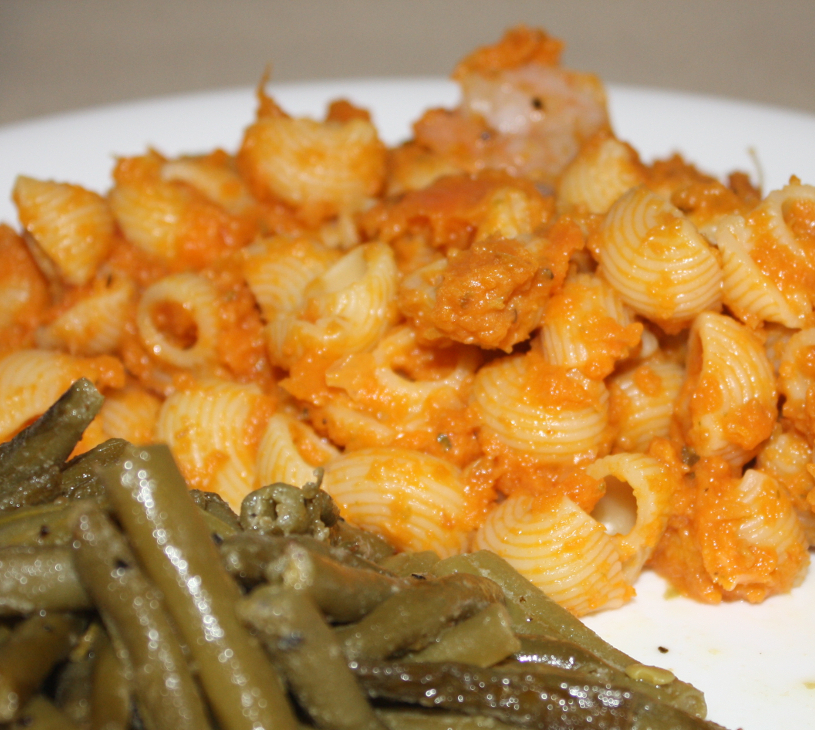
   Now about that ulterior motive. The above broth was made for a homemade ramen meal. But what should become of those strained solids? Because knowing me, they've got to go as far as they can before I'll consider ditching them. Two days later, the vast majority of them found their way into a potato-leek soup. I searched out the onion and garlic skins, those 3 bay leaves, and however many carrot ends there were, and the rest of the broth scraps landed in a pot with gold potatoes and a splash of water. The conglomerate was boiled and then puréed, a process which took quite a while to do completely with one of those hand-blenders, and finally simmered with milk, cream, butter, salt and pepper, and thyme. The end result? C'est magnifique!

January 11, 2015 - Potato Leek Soup

   Cooking with vegetables is the safest route to take, and saving up those scraps comes second nature now, but this summer I decided to take advantage of another easy-to-cook element: shrimp. And all of those endeavors deserve their own post (to follow), but I'm glad I chose early on to purchase the "EZ-peel" flash-frozen shrimp. Frozen, because chances are any fishermen-caught shrimp were already frozen at some point; and easy-to-peel because the beheading and deveining process actually makes it so. Plus, if they're pre-peeled, you're only robbing yourself of that tasty layer. Once sufficiently thawed, their shells were peeled and refrozen until the point where I'd accumulated enough for a long-desired homemade shrimp stock.
   Technically, a stock is created to serve its purpose as a base (for soup, sauce, gravy, etc.), whereas a broth is considered complete on its own. Stock would more likely be concentrated with a richer flavor (more commonly using meat or bones), while broth is mild and owes much of its taste to seasoning. And because I made the following to be added to my trial gumbo, it may indeed be called a "stock"—though shrimp may not have ended up the proper star of it.
   The overwhelming flavor of this stock came from one vegetable which I'd underestimated. You may recall my mention of onion, carrot and celery as foundational ingredients, but the thing about these (and especially celery) is that the denser or more tightly packed cores hide a lot of flavor. So it was, that when I used the entire celery heart in addition to a stalk or two, the essence of the vegetable overpowered everything else. All I'm going to say, then, is remember to keep the balance.
   Before anything else, approximately 1 pound's worth of shrimp shells (along with garlic skins and onion skins) was tossed into the pot and cooked from frozen, until they gained color and basically separated from each other. Then came the famous triplex of fresh onion, carrot, and celery, along with garlic and thyme. And finally, water to cover, a tasty splash of Sauvignon blanc, a dollop of tomato paste, and a touch of salt and pepper set this medley ready to boil and simmer for 1 hour.

July 21, 2015 - Shrimp Stock

   Of course, the final step was straining, and this time we did right. If you've already read the roux-and-gumbo post, you'll know that we'd gone to IKEA by this time. We invested in a proper mesh strainer, and I bought cheesecloth from a supermarket, so I was actually able to mash and press this stuff against it without fear that the filter would break. Then, dividing the perfect (albeit celery-y) product between two containers to be refrigerated for the next day's meal, it was time to address the leftovers.
   The idea for potato-leek soup came hand-in-hand with the first broth I'd made. These leftovers, however—sans anything I knew wouldn't blend well (shells, skins and thyme stems)—sat in our fridge for a while before I finally thought of a way to use them. I shoved them in our food processor, pulsed them with some oil, and ultimately wound up with a carrot purée. This I added to pasta, and shrimp (because, summer), and was reminded of pasta fagioli...in appearance only, I assure you. Edible? yes. Tasty? somewhat. Satisfying? on many levels.

August 7, 2015 - Shrimp Primavera

9.09.2015

In Hot Water

   Water is perhaps the most important part of your kitchen experience. Now, it may come as obvious to all of you that water is a requirement for life. But for me growing up, you'd think I confused it with alcohol. I did not drink water. And everyone around me knew this. Originally, it was because I didn't like the taste, and for a long while that excuse lived on. I mean, it has no taste. If it did, you'd know there was something wrong with it.
   Without getting too far into my ideology, this is the reason a lot of people don't like tap water: because of the taste. Do you know what that taste is? Metallic. Go figure, in most developed places it runs through metal pipes. But these sorts of "impurities" don't usually make the water unsafe. That's because—and looking at a box of Cheerios will help—a proper diet contains a lot of otherwise metallic-sounding nutrients. These are ecologically known as inorganic compounds and dietarily known as micronutrients; but since we were children, we've been calling them "[vitamins and] minerals."
   Think about it a mite longer. The people who don't like the taste of tap water would either prefer to buy bottled water (the greatest French scheme in the history of the world), or to filter it by their own means (e.g., Brita). With the former option, you're most often paying money—and are well aware of the fact—for "mineral water." The chemical composition may in fact be very similar to tap water, but the taste, or lack thereof, comes from the amounts of micronutrients in any given water supply.

Colorado Springs, CO

    Most drinking water is sourced to springs, aquifers, wells, etc.; in a word: groundwater. For the most part, the deeper the source, the "cleaner" it is. The best way to understand this is to imagine the earth's crust as one giant filter. There are layers of soil-types (humus, loam, sand, clay) and more often blends of them. As water passes through one (and once in the ground, water is not necessarily guided by gravity; consider capillary function, for those of you in the medical profession), it is both filtered of larger impurities and—depending on the layer's capabilities—actual molecules, as well as absorbing or taking on other impurities, including microbes (bacteria).
   Microbial life is the organic side of water, and you would be surprised to view the community in a single drop of untreated water. "Untreated" is the keyword, because the powers that be see fit to treat water from its various sources for the sole purpose of killing those bacteria which would otherwise thrive in it. Arguably, most bacteria are harmless. Actually, some of them are quite beneficial, to the point where some might be used to remove compounds more detrimental to our health (research "bioremediation of contaminated sites"). But when it comes to the water the American population will literally bathe in and ingest, there's no splitting hairs. All treated water is pasteurized (i.e., heat-treated) to kill off bacteria and denature viruses which may otherwise be present.
   Make a mental note of that.
   The other side, the people who filter their own water, hold two main advantages. First, to which Jes and I can attest, it's cheaper. We used to buy ~1 Gal. jugs at $1 each, ten at a time, once or twice a month. That works out to maybe $150 a year. And that's only possibly worth it if you're only ever purchasing water in bulk. Because a movie theatre or a college vending machine can sell a half-liter of water for anywhere from $2.50 to $4! And I won't begin my rant about the irritating sound of lifting a 24-case of Poland Spring.
   Filtering your own water also gets a one-up against drinking tap water on the off-chance that you're experiencing a water-main break or some flow issue at the treatment facility, the latter of which commonly results in higher percentages of those inorganic compounds. It is extremely important to note that a break in the water main implies bacterial infection, and a home-use filter will not clean water in that regard. Only boiling will do that, and specific guidelines for taking care of the water in your area, should something like this occur, would be publicized by your local treatment facility (or found here).
   Our Brita has been tested to lower the levels of copper, mercury, cadmium, chlorine and zinc. The last two strongly affect taste, and while chlorine is added to keep water microbe-free, the amount of it present in your government-regulated tap water is considered safe. (Frankly, if you've seen the water the majority of the world puts up with, chlorinated drinking water would look very attractive.)

Freshwater

   There. Now that all the technical is laid out, where were we? Mineral water exists for the same purpose as iodized salt: to provide us with micronutrients in the most pleasing way we can think of. You're having salt? You may as well get your iodine intake. You're drinking water? Have some manganese. I just realized how much that sounds like "the language of manga."
   OK, focus. Heat kills bacteria. It does not necessarily purify water. That process is know as "distilling." Unless you love your vodka, you'd most likely think of how a survivalist might treat seawater to turn it into drinking water. The same concept follows through in your kitchen. Boiling water does not boil away the impurities, such as salt in seawater or other minerals in tap water. Instead, it actually concentrates them. Because the water is escaping in the form of steam, and it is the steam that is becoming purified. When people boil seawater, they collect the steam, let it condense in a separate vessel, and drink that.
   Distilling may be one [very intensive] way of getting down to pure H-O-H compounds, but what it boils down to (ha!) is what kind of water do you want in your food? It's really as simple as what you are willing to drink.
   Growing up, I didn't drink water, but I still ingested it. Eight glasses a day seemed a bit much, but considering all of the fruits and vegetables I ate, I got my fair share. And of course, with all the tea.... Tea is actually the top reason I started drinking water. I'd get a cup of hot water, add some sugar, and suddenly I was one step closer to being a normal animal. In time, I downgraded to cold water with sugar, and even sometimes settled for sugarless because I actually didn't mind the flavor at the water cooler. Now, I even go so far to drink the free stuff that's always been put in front of me at restaurants. Saving money and increasing health: eat your heart out, organic movement.
   That said, until we bought our Brita, I've been filling pots with tap water out of ease. I don't drink tap water. Except, the water in the shower at my mom's tastes sweet. That may have been the closest I came to willfully drinking water as a kid. Anyway, kitchen. I don't drink tap water, but when making rice or pasta, it's just so easy to run it from the faucet. Especially when you're rinsing the rice through a few times. Or even rinsing vegetables, or settling grit out of a head of lettuce.
   But now that Brita sits in our fridge day in and day out, I use it whenever it's staple. If water's in the meal, we'll use the best that we have. It's like being fresh...with water!

To Salt, or Not To Salt?

   I have heard it said, that salt added to water acts as a temperature buffer, that it decreases the freezing point and increases the boiling point. Which is to say, saltwater remains liquid longer than freshwater would. For our kitchen purposes, however, this is the same kind of science which tells us about the clockwise rotation of water currents in the northern hemisphere, while the southern hemisphere is dealing with a counterclockwise rotation. The point to be made is, on a grand scale (e.g., globally), it does apply. But on a significantly smaller scale (e.g., a pipe drain), it doesn't.
   I tried to put this to the test, by boiling water with and without salt to determine which would take longer. As it turned out, we have no two pots alike in our kitchen, so what I was really testing was which pot was best for taking heat. If only I'd known that from the start. My first experiment? Two small burners on our electric stove, started at the same time and turned to the same number (9), with 4 cups of tap water in one pot, and 4 cups of tap water + perhaps a tablespoon of dissolved table salt in another. Result? 10 minutes for the first, and 9 minutes for the latter. Not exactly gone to plan.
   The second experiment needed some adjustment. This time, I put the salted water in the "worse" pot and the simple tap water in the "better" pot, and swapped the burners for good measure. Result? 9 minutes for both. My hypothesis busted, even Jes held an air of disappointment when she came in to realize I was only "cooking water."
   I thought a moment, at least a day, and considered the dissolved molecules already present in our tap water. So I recreated the experiment a third time, just once over, using Brita water. And I salted the worse pot this time. Result? 8 minutes for the better pot of filtered water, and perhaps the same for the salted version. And curiously, the water was colder this time around than the first two experiments, as observed by the condensation that formed. So as you can imagine, I was more thoroughly confused than ever.
   The fact is, it really doesn't matter—I mean, it really doesn't matter whether you add salt before boiling your water or after. The difference in the time is so miniscule, so easily mistaken (I first noticed bubbles the other way around, but the rolling boil happened contrarily), that your consideration for it should not even be. Understandably, a larger quantity of water will take longer to boil than ~10 minutes, but it is the amount of water which apparently marks the difference, more so at least than the amount of salt present (see here, noting the conclusion).

A Good Egg

   Now, salted water means well when making pasta. It keeps the noodles from sticking together—apparently. You see, I rarely have much luck with this one way or the other. I used to be under the thought that rinsing the pasta would make it stick, back when I was so ignorant to not even be putting salt in the water that dared to be rinsed away. But even now, I find that my noodles, on their own, are either noticeably salty or as equally bland, and stuck to each other regardless. I've also heard that using oil, as a salt-substitute, would get the job done, as each piece of pasta would presumably be coated in it upon entering the dancing pot. I could talk on that all day, but the facts remain: pasta in our kitchen (under my supervision, at least) is very clingy. *Edit: the solution is as simple as stirring for the first minute of cook-time.
   I bring that up because that may be the only instance when salt might possibly be needed: for its chemical reaction, whatever that may actually be. Salt has no place in water boiled for an egg, or for blanching, a similar process. The water will be discarded as soon as the food is cooked, and unlike pasta, its absorption is not a factor.
   If you're expecting to find the best way to cook an egg, you needn't look outside your own kitchen. That's because everyone has a different preference. Speaking on how to cook an egg is like telling people how to make coffee. And honestly, it's much the same thing for me, seeing as I dislike both. However, my story with eggs is actually a fond one, and it began—as good stories often do—at home.
   When I was a lad, I sat upon my papa's knee and ate scrambled eggs with catsup. When I grew a little older, I distanced myself altogether from the taste and texture of egg. It's probably true that I never really liked it, which is why there was always ketchup on it. My grandfather's mannerisms had taught me that putting ketchup on everything was an insult to the cook. That was about the time I replaced it with mint jelly, in his kitchen at least. (He cooked lamb-burgers, just so you and I are on the same page.)
   Anyway, it had gotten to the point where there was only one way I would eat my eggs: hard-boiled. And if you think about it, it's the simplest way to do so, short of going Rocky-style on them. As long as you've got a clock and a pot, and water that's hot, you cannot mess it up.

Eggsplosion

   One-in-ten eggs that I hard-boil end up something like this. That's because my own method changes with the time of day. Sometimes I put the eggs in first and then cover them with water, just so I know I have enough liquid. The problem with that is the need for time-adjustment. For, if you don't know how to hard-boil an egg, 10 minutes of high-heat is about par. If the eggs are there from the start, slightly more time should account for the water reaching its boiling point, which in turn cooks the egg part-way. I aim for 13 minutes when I use this method. And to make certain the eggs do not exceed that limit, I douse them in cold water after dumping the majority of their bath. Never have I had an undercooked egg in this fashion, though it is overcooked which I equally detest, which is why the timing is crucial.
   Other times, I go the 10-minute route, dropping the eggs [as gently as I can] into the bubbling cauldron from which there is no escape. I've never burned myself in this way; yet, I've also seldom had an egg that didn't crack in the process. What's pictured above is by far the worst-case scenario. Look at it. It's borderline ABC gum. I know what you're thinking, and yes, I've tried using a spoon, but we don't have anything remotely like those fryer ladles, which I think would be perfect for the job. It also probably doesn't help that the pots I use are shallow. But then again, what's life without a few cracked shells?

Half-Frozen, Hard-Boiled

   If you thought timing the eggs' cooking was troublesome, peeling them afterward is enough to make you loathe their entire being. I've read dozens of people's trials and tried some of them myself. To settle things: it's like expecting salt to keep your pasta from sticking. I'd advise, of course, against daring to peel them immediately, only because your fingertips would hate you for it. I've tried rinsing them for a little bit, but they keep their heat so well. I've tried once they reached room temperature, and the result is about the same as when I refrigerate them overnight. It probably has something to do with the choice of egg itself, as if I could tell anything apart from its color.
   The problem is, the albumen tends to stick to that thin film, which in turn sticks to the shell. So, after you've dented your hard-boiled beauty and are just about ready to reveal its perfectly cooked, oval shape, expecting all the while to get a big piece of the shell off in one go, as though you were peeling that one orange immortalized in your memory forever, lo! and behold, a white chunk lifts out, leaving an extremely noticeable gouge mark that reminds you of the time you pulled flesh from flesh when getting your finger caught in something. The feeling is the same. Really, it is.
   But, it'll taste the same regardless of what it looks like. I mean, it's an egg. It's not exactly appetizing to begin with. It "coulda been a contenda" for a cute li'l baby chick. Instead, now that it's cooked and peeled, and rinsed to get every bit of film and shell away from its less-than-pristine surface, it's time to dissect it. Presuming you're not simply interested in sprinkling it with salt and biting into it—my favorite use for them, short of seeing how high they can bounce—you slice it with the high hope that the yolk had settled toward the rounder part of the egg, or that it'll at least be centered upon the plane you cut. If this is the first moment that the egg disappoints you, consider yourself lucky and remember: it'll taste the same.

Recycled Recipes

   I've mentioned once before that following in others' footsteps is a good thing. Indeed, before the age of copyright, it was a sign of respect to build off of something that another had created. By that token, the following is the best egg-centered dish I've ever made or eaten, and I can only thank the minds behind it. The recipe is from smitten kitchen (as if you should doubt), the blogger of which found it in a book, the author of which presumably composed it from a twist on the Caesar salad.
   Jes has become a connoisseur of Caesar salads, similar to me with Reubens, or both of us with French onion soups. They're items we order whenever we have the chance, always tallying a score that we try desperately to remember along with location. My favorite Reuben, we had on our honeymoon. Our favorite Caesar included a halved head of romaine grilled with the flavors of past burgers, also on our honeymoon. French onion? more difficult to remember (our honeymoon's version didn't cut it, and our tastes are strict). But they're also items we wouldn't dare to make at home—from scratch, at least. Though they'd probably be worth the effort, I believe they all belong in the restaurant, because that's where they all gained their fame.
   Now, there are certain aspects of the Caesar salad that make it "authentic." The raw egg is one, the anchovies another and lest we forget, the chopped romaine lettuce. Interesting though it may be, none of these were included in the original. The egg was apparently partially, slowly cooked, the flavor of anchovies was hidden within Worce-ster-shire sauce, and the lettuce leaves were kept whole. Talk about mind-blowing.
   This recipe brings the egg under the spotlight, with all the famous flavors of the salad, dressing it up instead of the other way around. It breathes new life into the old-fashioned deviled egg, and with platters of leaves it pays homage to Caesar Cardini himself. I followed this to the T, aside from using a Ziploc in place of an actual piping bag. And the result? As delectable as it looks:

December 25, 2013 - Caesar Deviled Eggs